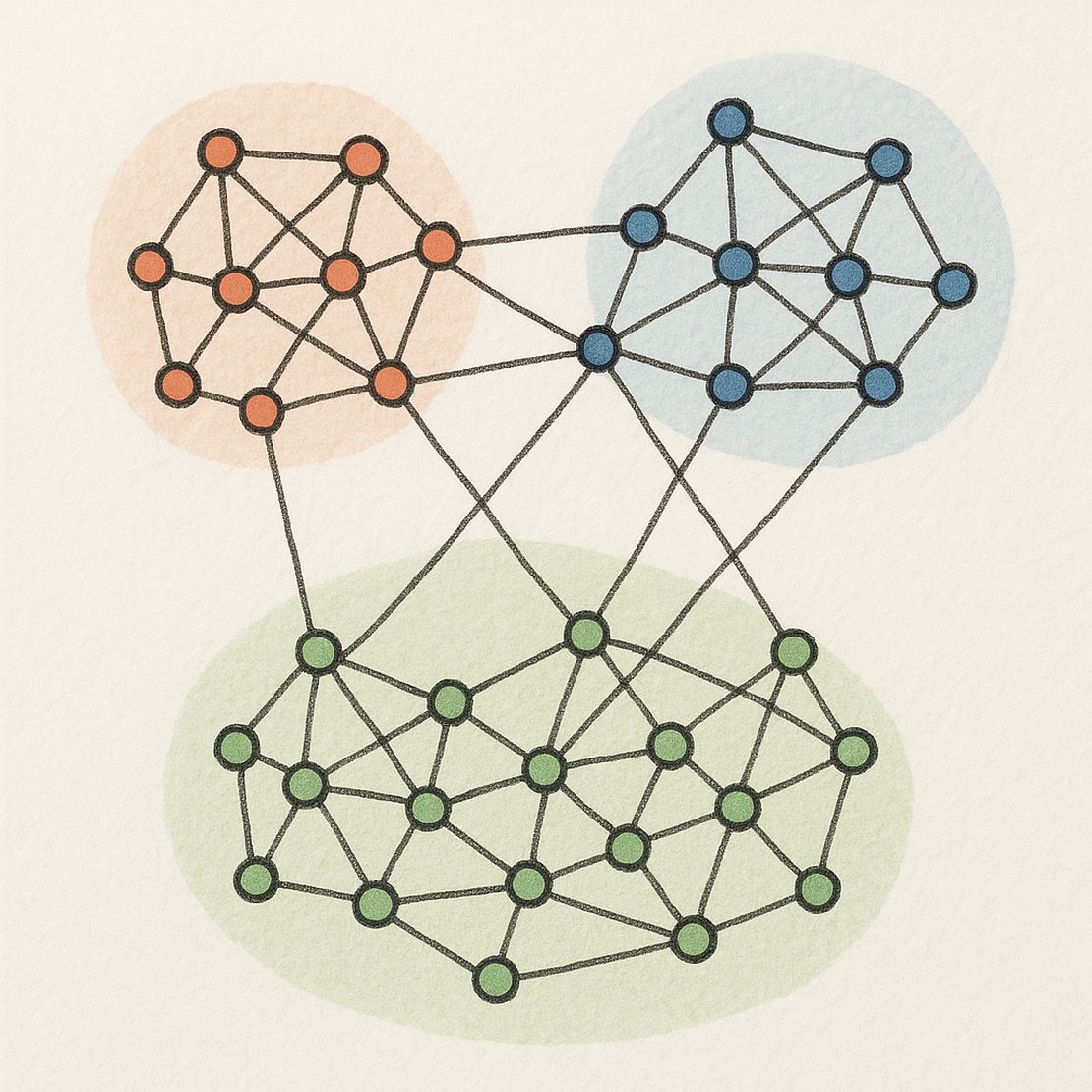
Community detection problems
- RedHEUR4.0 Network
- December 24, 2018
Table of Contents
Community Detection
Problem Description
Community detection refers to a class of combinatorial problems centered on identifying cohesive groups of nodes within complex networks. These communities, or clusters, are typically characterized by:
Dense intra-community connections: Nodes within the same group are highly interconnected.
Sparse inter-community links: Connections between nodes of different groups are fewer or weaker.
Modularity optimization: Maximizing a quality function that measures the strength of division of a network.
Hierarchical or overlapping structures: Accounting for multi-scale or non-exclusive memberships.
These problems are fundamental in network science and graph theory and have broad applications in sociology, biology, computer science, and cybersecurity. Most formulations are NP-hard, requiring heuristic, spectral, or learning-based methods to approach large-scale networks effectively.
Industrial Context
Community detection plays a pivotal role in industries dealing with large-scale relational data, such as social media, telecommunications, e-commerce, and bioinformatics. Applications include:
Social network analysis: Identifying user groups, influence propagation, and targeted marketing.
Fraud detection and cybersecurity: Discovering suspicious substructures or coordinated behavior.
Recommender systems: Enhancing personalization based on group behavior.
Biological networks: Discovering functional modules in protein interaction or gene networks.
In the context of Industry 4.0, interconnected devices and cyber-physical systems generate massive interaction graphs. RedHEUR4.0 contributes by offering scalable and adaptive methods for real-time structure inference and anomaly detection in dynamic networks.
Common Challenges
- Scalability: Processing millions of nodes and edges in dynamic or streaming graphs.
- Resolution limit: Detecting both large and small communities accurately.
- Overlapping and hierarchical detection: Capturing complex node affiliations beyond flat partitions.
- Evaluation metrics: Choosing robust and domain-appropriate measures like modularity, NMI, or conductance.
These problems demand hybrid and data-driven approaches that balance interpretability, speed, and accuracy in evolving network environments.
Solution Approaches
RedHEUR4.0 promotes the use of:
- Metaheuristics: Variable Neighborhood Search (VNS), Ant Colony Optimization (ACO), Iterated Greedy (IG)
- Multi-objective optimization frameworks
These strategies improve operational efficiency and support sustainable, interpretable, and customizable community detection workflows applicable across sectors.
References
- Borgatti, S.P.; Everett, M.G.; Johnson, J.C. Analyzing Social Networks; Sage: Thousand Oaks, CA, USA, 2018.
- Girvan, M.; Newman, M.E.J. Community structure in social and biological networks. Proc. Natl. Acad. Sci. USA 2002, 99, 7821–7826.
- Dorogovtsev, S.N.; Mendes, J.F.F. Evolution of Networks: From Biological Nets to the Internet and WWW; Oxford University Press: Oxford, UK, 2003.
Acknowledgments
This summary was prepared by the RedHEUR4.0 network as part of its contribution to the digital transformation of the transportation and logistics sectors, supported by the Spanish Ministry of Science and Innovation.