
Our History
The Red HEUR network was founded in 2002 under the scientific promotion initiatives of the Government of Spain. Since then, this network has built a trajectory of more than 20 years of cooperation between research groups in the area of heuristic optimization, currently applying for its fourth edition.
Throughout its long trajectory, Red HEUR has developed and promoted the use of heuristics and metaheuristics to solve complex optimization problems using Artificial Intelligence techniques.
Current Focus: Industry 4.0
Currently, Red HEUR seeks to focus its attention on process optimization in the fourth industrial revolution. Commonly referred to as Industry 4.0, this revolution is primarily driven by the digitalization of the productive sector.
Our objective is to “stimulate the digitalization of the national productive fabric through the development and promotion of business solutions obtained as a result of applying heuristic and metaheuristic techniques to real optimization problems.”
Our Network: RedHEUR4.0
To achieve our planned objective, RedHEUR4.0 has the participation of 14 research groups expert in solving optimization problems through heuristic and metaheuristic techniques. These groups bring together 98 researchers from 14 universities and national research entities, and also have extensive experience in directing numerous previous projects of the National R&D&I Plan.
RedHEUR4.0 aims to improve the results obtained in these projects by fostering collaboration between participating groups.
Our Network Distribution
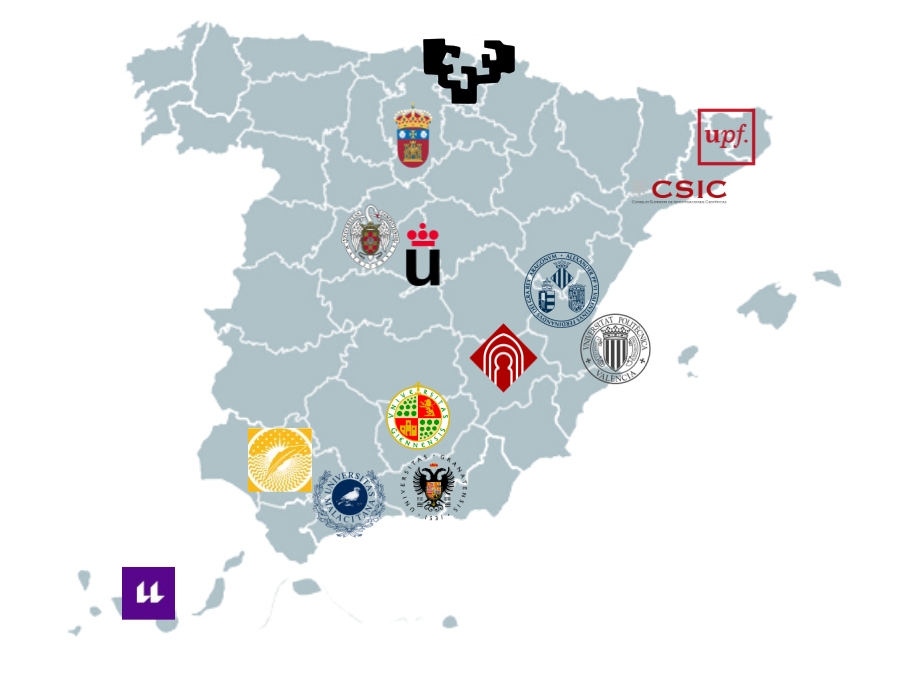
Red HEUR research groups distribution across Spain
Research Areas
This proposal is structured around four themes previously worked on by network members and which are also key in both Industry 4.0 and the supply chain:
- Manufacturing
- Warehousing
- Transportation
- Business Intelligence
The optimization of involved processes, such as delivery routes, product storage, or facility design, results in a wide range of benefits for society, both economically and socially.
Benefits Include:
Environmental Impact:
- Reduction of fuel consumption
- Decreased packaging materials
- Lower energy consumption in production plants
Workplace Benefits:
- Reduced workload for operators
- Decreased working time
- Improved working conditions
Open Source Initiative
Despite the experience of the groups and the work that the network has been doing for these 20 years, the benefit that the productive fabric has obtained from the results of previous research projects has sometimes been limited. The fundamental reason could be related to the lack of integration of the designed algorithms into business solutions that facilitate their use.
Therefore, one of the objectives of this proposal is to promote the release of scientific advances obtained by network nodes, as a result of previous research projects, as open source software. This contributes to the productive impulse of the industrial sector and the generation and dissemination of knowledge from universities.
Our Mission
Red HEUR serves as a platform for researchers to share knowledge, collaborate on optimization challenges, and bridge the gap between academic research and real-world industrial applications. We are committed to advancing the field of heuristic optimization while making our research accessible and beneficial to the broader community.
Financing
Red Española de optimización heurística 4.0 digitalización
| Project Duration | June 1, 2023 - May 31, 2025 |
| Funding Agency | AGENCIA ESTATAL DE INVESTIGACIÓN |
| Reference | RED2022-134480-T |
This project is funded by the Spanish State Research Agency as part of their commitment to advancing research and innovation in heuristic optimization and digitalization technologies.